
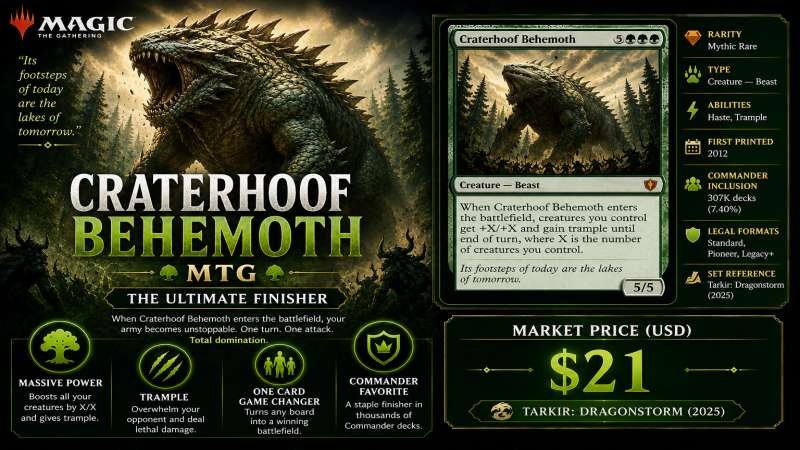
There are powerful cards in Magic: The Gathering, and then there is Craterhoof Behemoth. Few cards in the history of the game have ended as many matches, flipped as many tables, and caused as many jaws to drop as this eight-mana green Beast. Since its original printing in Avacyn Restored back in 2012, it has become one of the most iconic and consistently played creatures across Commander, Legacy, Modern, and now Standard and Pioneer following its reprint in Tarkir: Dragonstorm. For anyone who plays green creature strategies, understanding craterhoof behemoth mtg is not optional — it is essential.
Whether you are building your first Commander deck, grinding competitive Pioneer, or simply trying to understand why your opponent is grinning when they tap eight mana, this complete guide covers everything you need to know about craterhoof behemoth mtg in 2026.
Craterhoof Behemoth Card Details
| Detail | Information |
| Card Name | Craterhoof Behemoth |
| Mana Cost | 5GGG (8 total) |
| Card Type | Creature — Beast |
| Power / Toughness | 5/5 |
| Rarity | Mythic Rare |
| Keyword | Haste |
| Ability | When this creature enters, creatures you control gain trample and get +X/+X until end of turn, where X is the number of creatures you control |
| First Printed | Avacyn Restored (2012) |
| Latest Printing | Tarkir: Dragonstorm (2025) — TDM #138 |
| Other Printings | Modern Masters 2017, Jumpstart, Commander Masters, Innistrad Remastered, Secret Lair Drop |
| Current Price (AVR) | Approximately $18–$35 (non-foil) |
| Current Price (TDM) | Approximately $21 (non-foil) |
| EDHREC Inclusion | 7.40% — found in over 307,000 Commander decks |
| Total Decks Played | 7,511+ in the last year across all competitive formats |
| Legal Formats | Standard, Pioneer, Legacy, Modern, Vintage, Commander, Historic |
| Illustrators | Chris Rahn (original), Magali Villeneuve (Tarkir: Dragonstorm) |
What Makes Craterhoof Behemoth So Powerful
The reason craterhoof behemoth mtg has remained one of the most feared cards in Magic for over a decade comes down to a single ability that scales with the size of your board. When it enters the battlefield, every creature you control gains trample and gets +X/+X until end of turn, where X equals the total number of creatures you currently control. Crucially, Craterhoof Behemoth counts itself, meaning even a modest board of six creatures suddenly swings for devastating trample damage that is nearly impossible to block profitably.
What makes this ability truly dangerous is the combination with Haste. Unlike most expensive creatures that give your opponent a turn to respond, craterhoof behemoth mtg attacks immediately. There is no waiting. No telegraphing. You cast it on your main phase, your entire board becomes a trampling army, and in most games with a wide creature strategy, that is simply the end of the match.
Best Formats and Archetypes for Craterhoof Behemoth
For most of its history, craterhoof behemoth mtg was primarily a Commander staple and a Legacy Elves finisher. The Elf archetype in Legacy has long used mana-generating creatures like Priest of Titania and Elvish Archdruid to accelerate into Craterhoof as early as turn two or three, creating board states where the opponent simply has no meaningful response. In Commander, it has been a go-to win condition in virtually every green creature-based strategy for years, appearing in over 307,000 registered Commander decks on EDHREC alone — a 7.40 percent inclusion rate across the entire Commander card pool.
Its reprinting in Tarkir: Dragonstorm in 2025 changed the competitive landscape significantly by making it legal in Standard and Pioneer for the first time. In Pioneer, it has already made a splash in Selesnya Gearhulk, Green Devotion, and Elf-based strategies. In Standard, token decks pairing it with Elspeth’s token generation have produced boards where casting a single Craterhoof ends the game before the opponent can draw another card. The competitive community has taken notice, and craterhoof behemoth mtg is now being played across more formats simultaneously than at any point in its history.
How to Use Craterhoof Behemoth Effectively
The most important principle when building around craterhoof behemoth mtg is going wide before going tall. The card’s power scales directly with the number of creatures on your side of the board, so strategies that generate multiple small creatures — Elves, tokens, Saprolings, or any wide tribal theme — benefit far more from a single Craterhoof than strategies relying on a few large creatures.
In practice, a board of six creatures including Craterhoof Behemoth itself gives your team +6/+6 and trample. With ten creatures, that becomes +10/+10 across the entire board. With fifteen Elf tokens and Craterhoof, you are swinging for numbers that no reasonable blocker arrangement can stop. The ideal play pattern is to build your board across several turns, protect it from sweepers, and then find Craterhoof either by drawing it naturally, tutoring with Green Sun’s Zenith or Natural Order, or cheating it into play through reanimation effects.
Craterhoof Behemoth Price and Availability in 2026
One of the practical questions players ask most frequently about craterhoof behemoth mtg is what it costs and which printing to buy. The original Avacyn Restored printing currently trades for approximately $18 to $35 in near mint condition, reflecting both its age and the historical demand before recent reprints. The Tarkir: Dragonstorm version, illustrated by Magali Villeneuve with brand new artwork, currently sits around $21 for non-foil copies and $22 for foil, making it the most accessible entry point for new buyers who want the card for competitive play.
For Commander players on a budget, the Jumpstart and Commander Masters printings offer slightly lower price points and are widely available through most online card retailers including TCGplayer and Card Kingdom. The Secret Lair versions carry a premium for collectors, while the Innistrad Remastered printing represents another affordable option. Regardless of which version you choose, the card’s functionality is identical across all printings — only the artwork and collector number differ.
Why Craterhoof Behemoth Remains King in 2026
Many cards have been printed over the years with similar large-board-buff effects. Pathbreaker Ibex, Finale of Devastation, and Pyrewood Gearhulk all compete in the same design space, and skilled players do choose them in specific Commander builds. But none of them combine the self-buffing effect, the immediate Haste, the trample grant, and the tutorability in green — particularly through Natural Order and Green Sun’s Zenith — that make craterhoof behemoth mtg uniquely and consistently the strongest option.
Card Kingdom’s own analysis concluded that while alternatives exist for specific strategies, Craterhoof Behemoth remains the best mass buff effect in Commander because of how easy it is to search for, how immediately threatening it is the turn it resolves, and how few answers most decks have without blue countermagic or instant-speed board wipes. After more than a decade in the format, that assessment has not changed. If you are building any serious green creature deck, craterhoof behemoth mtg belongs in it.
Final Thoughts
Magic: The Gathering has produced thousands of powerful cards across its thirty-plus year history, and very few of them have remained as universally feared, consistently played, and openly respected as craterhoof behemoth mtg. It first appeared in Avacyn Restored in 2012, and in 2026 it is more available and more legal in more formats than at any point in its entire existence. That trajectory tells you everything about the card’s staying power.
Whether you are casting it to end a Commander game in explosive fashion, tutoring it up in a Legacy Elves combo, or slamming it in a freshly legal Pioneer token deck, craterhoof behemoth mtg delivers the same result every time — a board full of trampling, oversized threats that close the game before your opponents have a meaningful answer. In a game where so much changes every year, that consistency is genuinely rare. And that is why it will continue to be one of the most talked-about, most purchased, and most feared cards in Magic for years to come.
Frequently Asked Questions (FAQs)
What does Craterhoof Behemoth do in MTG?
When Craterhoof Behemoth enters the battlefield, all creatures you control gain trample and receive +X/+X until end of turn, where X equals the total number of creatures you control at that moment. Because it also has Haste, it can attack the same turn it is cast, making it one of the most immediately impactful creatures in the entire game.
What formats is Craterhoof Behemoth legal in?
Following its reprint in Tarkir: Dragonstorm in April 2025, Craterhoof Behemoth is currently legal in Standard, Pioneer, Legacy, Modern, Vintage, Historic, and Commander. It has been a format staple in Commander and Legacy for over a decade and is now making competitive noise in Standard and Pioneer for the first time.
How much does Craterhoof Behemoth cost in 2026?
The most affordable versions currently trade between $18 and $22 depending on printing. The Tarkir: Dragonstorm version sits around $21 non-foil, while the original Avacyn Restored printing can reach $35 in near mint condition. Foil copies across all printings command a significant premium.
What is the best deck to play Craterhoof Behemoth in?
In Commander, any wide green creature strategy — particularly Elf tribal, token decks, or creature-heavy ramp builds — benefits enormously from Craterhoof Behemoth as a finisher. In competitive formats, it is most effective in Legacy Elves, Pioneer Green Devotion, Standard Selesnya token builds, and Modern Devoted Druid Combo lists that can generate large creature counts quickly.
For more insights and detailed guides, visit our website for the latest updates